
The concept of everyday life is key to Island Lives as through it helps us bring to light how people challenge social structures through their daily practices. French sociologist Michel de Certeau[1] theorizes everyday life as the creative, tactical practices of ordinary people navigating and resisting the “strategies” imposed by dominant powers, in the case of the ABC islands, the strategies of the colonial Dutch West India Company. Rather than viewing daily routines as passive or merely habitual, de Certeau emphasizes the “art of doing ”— the inventive ways individuals appropriate, reinterpret, and sometimes subvert the norms, spaces, and products dictated by social institutions or authorities. Everyday life, in this sense, is not a static backdrop but a dynamic field where the “weak” employ tactics — small , nearly imperceptible acts of adaptation and resistance — to carve out autonomy within the constraints of established systems. These tactics can be seen in mundane activities such as cooking, doing business, or speaking, where individuals and communities rearticulate imposed ways of doing things by creating their own sui generis alternatives.
Archaeologists drawing on de Certeau’s framework focus on the material traces and spatial practices that reveal how people in the past negotiated materiality, culture, and power in their daily lives. Everyday life is thus understood as a network of practices — often fragmented and heterogeneous — through which people “make do” with what is available, transforming spaces into lived places through acts of appropriation and micro-resistance. This approach highlights the importance of studying not only grand historical events or elite structures, but also the ordinary, often overlooked peoples and their actions that constitute the fabric of social life. By foregrounding the agency and creativity of everyday actors, de Certeau’s concept allows archaeologists to interpret artifacts, built environments, and spatial arrangements as evidence of ongoing negotiation, adaptation, and resistance within broader social systems. In IslandLives the conceptual framework of assemblages of practice helps us make sense of how human-thing entanglements underwent changes or maintained continuities in everyday life, revealing alternative modernities.
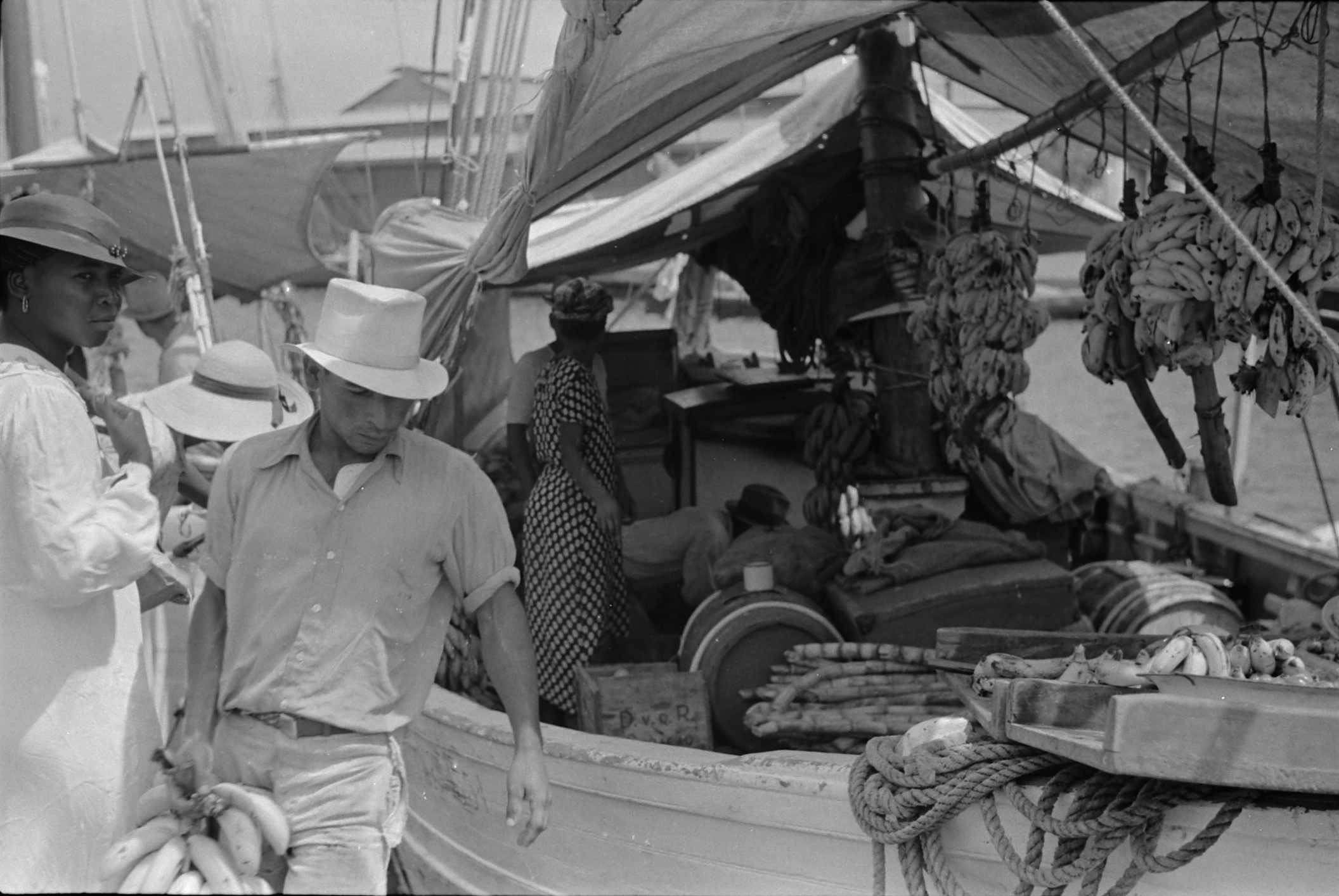
Banana Boat, Curacao, 1938, Curaçao, by Eric Lee-Johnson
[1] De Certeau, Michel (1984). The Practice of Everyday Life. S. F. Rendall translation. University of California Press, Berkeley.


