
Entanglement is a concept increasingly used in archaeology to help us better understand the close ties between humans and things. The idea builds on anthropologist Nicholas Thomas’s seminal study of how gifts and trade goods shaped relationships between Pacific Islanders and Westerners, but it was archaeologist Ian Hodder who developed it into a broader theory useful for archaeology.
Entanglements start with the simple connections between people and things, whether it be buying a new set of plates, periodically replastering the wall of your house, or depending on your trusty fishing net to feed the family and earn some income. These connections often create positive dependence: humans rely on things to live and things can improve our everyday lives, they can enable us. Things, however, also can limit or shape what people are able to do by entrapping us and drawing us into relations of negative dependency, making it harder to disentangle from these relations through time.
Entanglements between humans and things can be thought of at three different scales: knots, meshes, and the meshwork. Everything begins with a knot where the lives of people and the itineraries of things cross and become tied together. These knots form in everyday actions — like someone buying a new set of plates or a group of friends sharing a meal — and they create relationships of enabling dependence and constraining dependency. Over time, in everyday life, knots gather into meshes, which are clusters of entanglements shaped by shared tasks or contexts. For instance, the crew of a small sailing ship forms a mesh, bound together not only by their work and close quarters but also by the limited set of things they live with on their voyages. Meshes of entanglement in the past can be fleshed out archaeologically through the conceptual framework of assemblages of practice.
Finally, there is the meshwork, made up of countless meshes. This larger structure represents the big picture of entanglement, showing how humans and things are woven together across generations. In the meshwork, we can see both sweeping changes — such as shifting styles, the rise and fall of empires, or the spread of new ideas — and also important continuities, as people resist, adapt, and innovate in the face of change. The meshwork thus connects local, regional, and global scales, helping us see how change and persistence unfold together over time.
By being attentive to these three scales of entanglement — knots, meshes, and the meshwork — IslandLives therefore aims to get at the heart of social inquiry: understanding how individual choices interact with larger social structures, and how both change and continuity shape human life across different spatiotemporal scales.
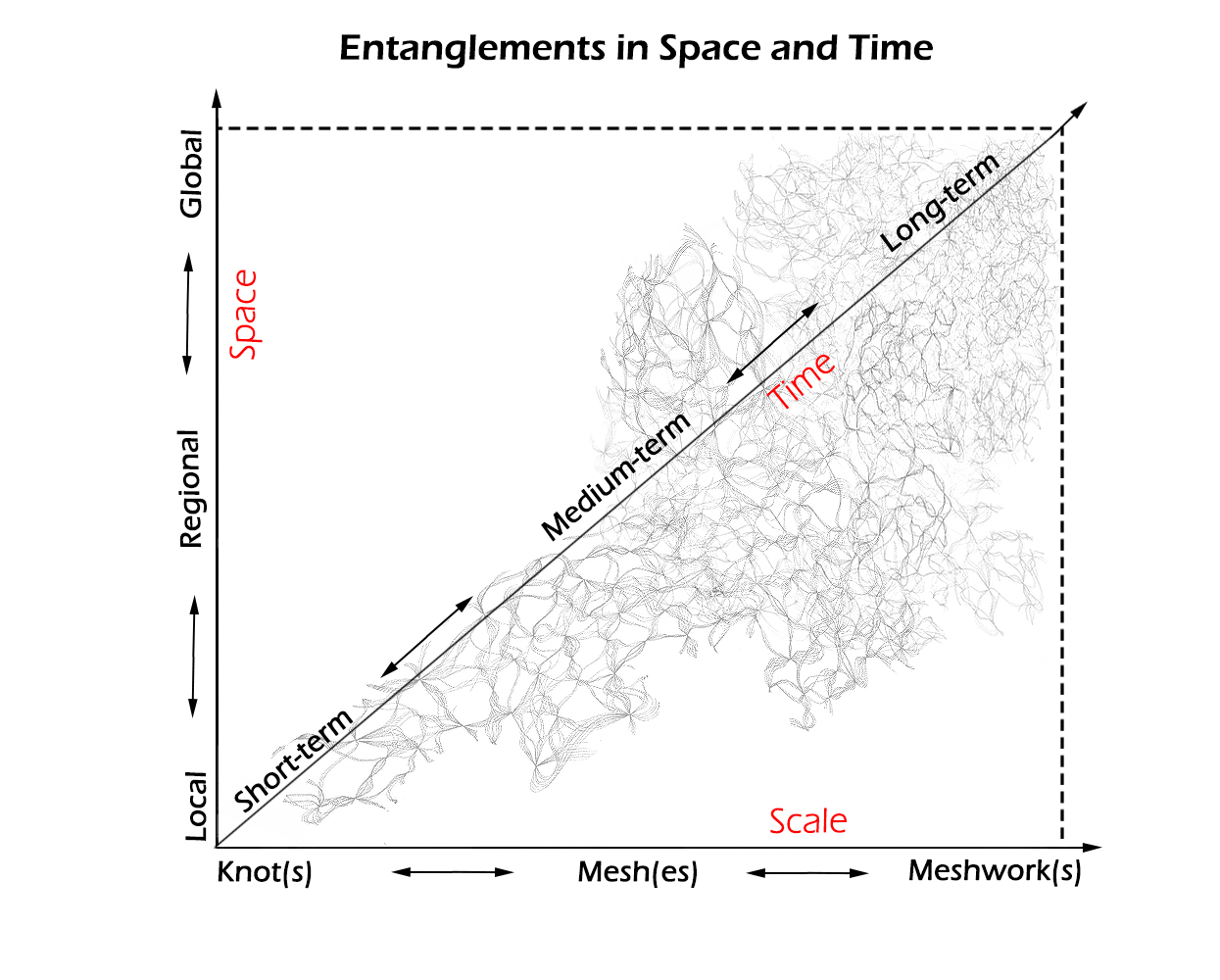
Diagram of entanglements visualizing them through space and time


