
To understand the conceptual framework of assemblages of practice we first have to explain both “assemblage” and “practice”.
Practice theory was developed by social scientists Pierre Bourdieu, Sherry Ortner, Marshall Sahlins, and Anthony Giddens to tackle a long-standing question in the social sciences: how do individual actions (agency) and larger social patterns (structure) shape each other? The core idea is that people embody, perform, and reinterpret social structures in their daily lives, and in doing so, they both reproduce and transform those structures. Archaeologists have adopted this approach to study the past, showing how practices like pot making, weaving, or trading were learned and shared within communities. These everyday actions in the past, even when they leave only faint traces, can often be rediscovered by retracing the entanglements between humans and things and by reassembling inert groups of objects into vibrant assemblages of practice.
While the English word “assemblage” suggests a static arrangement of parts, the original French term agencement conveys an active process of assembling, fitting together, and dynamism. This dynamic meaning aligns with how practices and human–thing entanglements actually unfold — in shifting, interwoven patterns rather than fixed structures. By using the term “assemblage of practice,” we highlight both the fluid, processual nature of human activity and the ways in which humans and things are bound together. This framework allows us to analyze the past in terms of change and continuity in everyday practices, without analytically privileging humans over things or reducing their relations to static connections.
Assemblages of practice therefore are theaters of entanglement. They are dynamic gatherings of things entangled through everyday human activities.[1] In this project, therefore, assemblages of practice is the conceptual framework that harmonizes the raw data we obtain and deep social theory. It is essentially a heuristic tool that can reveal changes and continuities through time and space in the practices of everyday life, where humans are constantly entangling and disentangling with things.
An assemblage of practice, for example, can be an assemblage of food preparation and cooking, involving things such as grinding stones, embers, clay cooking pots, and baskets of recently picket corn cobs and the Indigenous women employing these things to prepare meals, day after day. It can also be an assemblage of salt harvesting, entangling the workers, wheelbarrows, shovels, and the very sea itself. Crucially for IslandLives, this framework helps us illuminate how alternative modernities originate and operate through time and space.
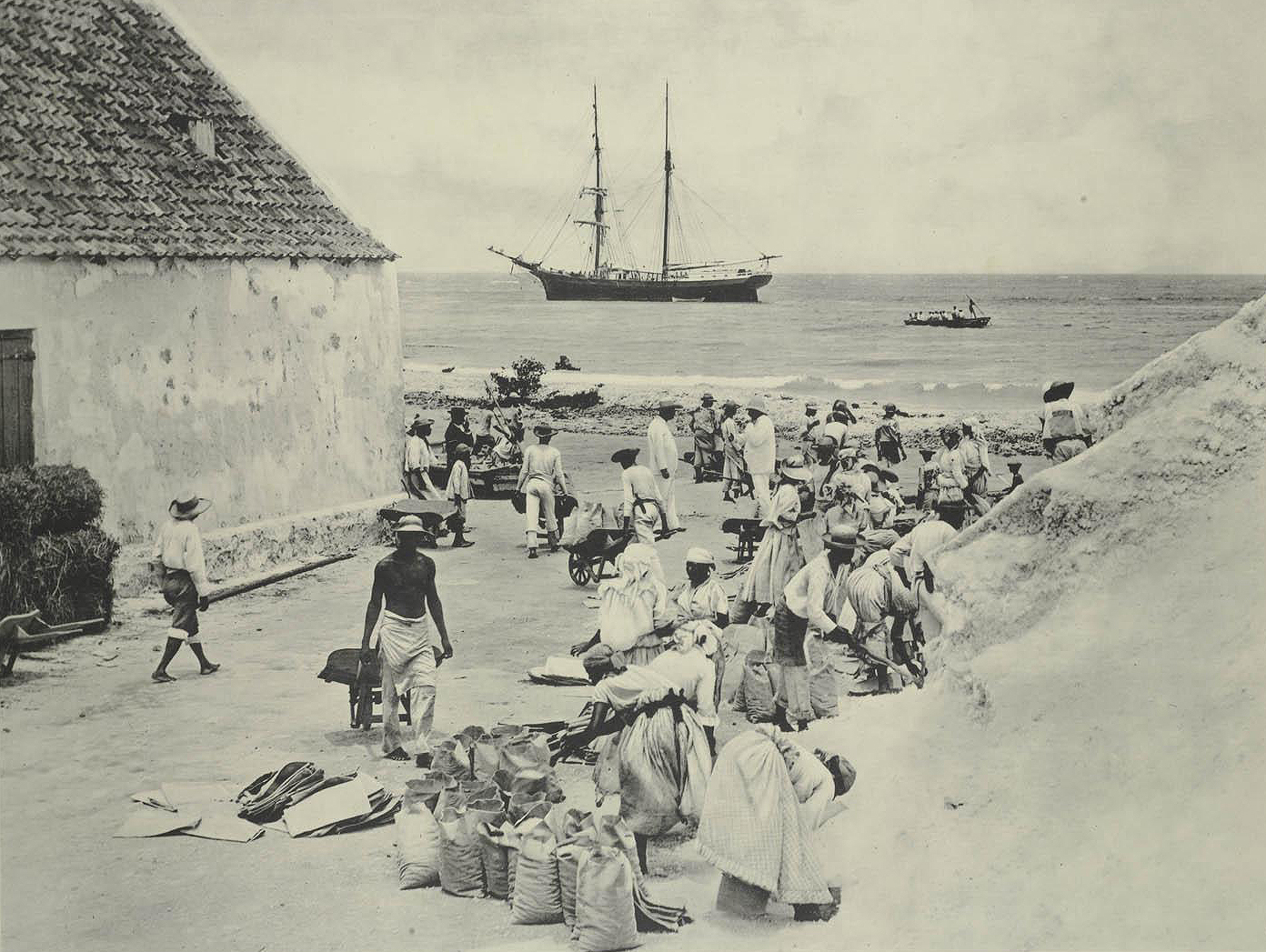
Curaçao salt industry, c. 1913, Jean Demmeni
[1] Antczak, Konrad A. and Mary C. Beaudry (2019). Assemblages of practice: A conceptual framework for exploring human-thing relations in archaeology. Archaeological Dialogues 26(2): 87–110.


